

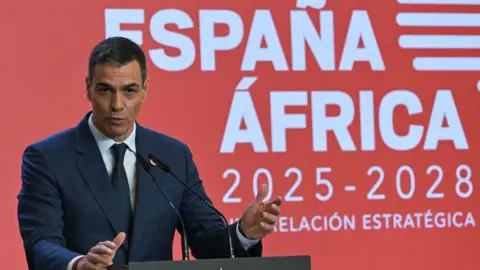
Madrid is adopting a distinctly different course from numerous European countries when it comes to migration policies and relations toward the continent of Africa.
Although states such as the USA, Britain, French Republic and Federal Republic of Germany are reducing their international support allocations, the Spanish government stays focused to enhancing its engagement, even from a reduced baseline.
Current Programs
Currently, the Madrid has been hosting an African Union-backed "world conference on people of African descent". The Madrid African conference will examine restorative justice and the establishment of a new development fund.
This demonstrates the latest indication of how Spain's socialist-led government is working to enhance and expand its cooperation with the continent that lies just a brief span to the southern direction, across the Straits of Gibraltar.
Governmental Approach
In July International Relations Head Madrid's top envoy initiated a new advisory council of distinguished academic, foreign service and cultural figures, the majority of them from Africa, to oversee the execution of the thorough Madrid-Africa plan that his leadership unveiled at the conclusion of the previous year.
Additional diplomatic missions below the Sahara desert, and cooperative ventures in enterprise and academic are planned.
Movement Regulation
The contrast between Spain's approach and that of other Western nations is not just in spending but in perspective and mindset – and nowhere more so than in dealing with migration.
Similar to other European locations, Administration Head the Spanish premier is seeking methods to control the entry of unauthorized entrants.
"For us, the immigration situation is not only a matter of ethical standards, unity and dignity, but also one of logic," the administration head commented.
Exceeding 45,000 persons undertook the dangerous ocean journey from West African coastline to the Spanish archipelago of the Canaries recently. Calculations of those who died while trying the crossing extend from 1,400 to a astonishing 10,460.
Effective Measures
The Spanish administration has to accommodate recent entrants, evaluate their applications and oversee their integration into wider society, whether temporary or more long-lasting.
However, in rhetoric distinctly separate from the adversarial communication that emanates from many European capitals, the Madrid leadership publicly recognizes the hard economic realities on the ground in Western Africa that push people to risk their lives in the effort to reach the European continent.
Furthermore, it attempts to move beyond simply denying access to new arrivals. Conversely, it is creating innovative options, with a commitment to encourage human mobility that are secure, organized and routine and "jointly profitable".
Economic Partnerships
While traveling to the West African nation recently, Sanchez emphasized the input that foreign workers contribute to the national finances.
The Spanish government funds educational programs for youth without work in countries such as the West African country, particularly for irregular migrants who have been repatriated, to support them in establishing workable employment options back home.
And it has expanded a "circular migration" initiative that gives persons from the region limited-duration authorizations to come to Spain for limited periods of seasonal work, mostly in cultivation, and then go back.
Geopolitical Relevance
The basic concept underlying Madrid's outreach is that the European country, as the European country most proximate to the continent, has an crucial domestic priority in Africa's progress toward inclusive and sustainable development, and stability and safety.
That basic rationale might seem obvious.
Nevertheless the past had directed the Iberian state down a distinctly separate route.
Besides a few Maghreb footholds and a compact tropical possession – today's independent the Central African nation – its territorial acquisition in the 16th and 17th Centuries had primarily been focused across the Atlantic.
Prospective Direction
The cultural dimension encompasses not only dissemination of the national tongue, with an increased footprint of the language promotion body, but also schemes to help the transfer of educational instructors and researchers.
Protection partnership, measures regarding environmental shifts, women's empowerment and an enhanced consular representation are expected elements in today's environment.
Nevertheless, the plan also places significant emphasis it assigns to backing democratic principles, the pan-African body and, in particular, the West African regional organization the West African economic bloc.
This represents positive official support for the organization, which is presently facing significant challenges after witnessing its half-century celebration spoiled by the withdrawal of the Sahel nations – Burkina Faso, the Malian Republic and the Sahel territory – whose governing armed forces have chosen not to follow with its agreement regarding democratic governance and good governance.
Concurrently, in a message directed equally toward the national citizenry as its sub-Saharan partners, the international relations office declared "helping persons of African origin and the fight against racism and immigrant hostility are also key priorities".
Eloquent statements of course are only a first step. But in contemporary pessimistic worldwide environment such discourse really does distinguish itself.


